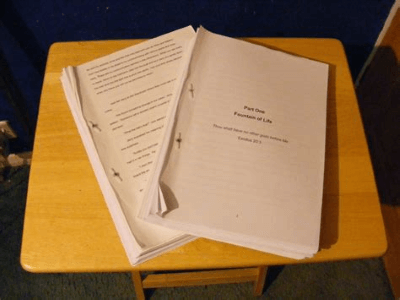
Submitting a book to a literary agent
April 20, 2024
This week I started sending out query letters to literary agents for my book "Stepping Out of My Comfort Zone." This process is long, slow, sometimes painful, and always not fun, but is a necessary evil if you have any hope of getting your book published by one of the "big 5" publishing houses.
So, what is the process? This is what I have found works best, but I am new at this, so there may be other methods that work better for some people.
To start with, YOUR BOOK MUST BE FINISHED, and preferrably been through several drafts, and getting it edited professionally is also a good idea. At the very least, an editorial assessment, and follow the suggestions from the editor. I've seen a couple of agents asking for editor names. Don't worry about doing a cover or interior formatting, don't worry about proof reading or even copy editing, all of that will be done by the publisher if/when the book is picked up by one.
So, let's get started into the world of submitting queries to literary agents.
First, create a spreadsheet. This is a must so you can keep track of your submissions and not submit to the same agency two or more times by mistake. Almost no agencies will accept multiple submissions, some say if they receive multiple from one person they will automatically ingnore and reject all submitted from that person. So don't do it.
You spreadsheet should have columns for:
- the name of the person you addressed your query to
- the name of the agency
- the website address of the agency
- the email address if you sent the query by email
- the date you submitted/sent the query
- the date you received a response (I do not include auto-responses, only real-person responses)
- what their response was
- what did you send (manuscript or proposal or query letter)
- method of submission (email or online on their web form or online on QueryTracker)
- a column for Notes
Second, get your various docs together. All you documents should be in Microsoft Word .docx format. You should have, finalized and fully edited, preferably not self-edited:
- sinopsys
- query letter
- proposal
- and a doc that has the following info (you may be asked for any of this info at any time from any of the agents, they're all different):
-
- Where did you find us?
- What are you various Social Media profiles?
- A short bio
- A long bio
- Other published works (short stories, poems, essays, etc)
- Describe in detail the good guy/gal
- Describe in detail the bad guy/gal
- Describe what happens when the good guy/gal and bad guy/gal meet
- Log line
- Tag line
- Hook
- A short description of the book (usually under 100 words)
- A long description (often no more than 500 words)
- Names of your editors
- Describe your target readers
- What is the age group you are targetting?
- Where can your readers be found?
- Comps (at least two)
- A list of keywords
- The bookstore category where you book might be found in a brick-n-mortar store
- Your marketing plan
- A teaser excert from the book, usually ends with "Read more at..."
That's a lot to have to think about and will take quite a lot of time, but it is necessary.
You will also need to have the first chapter set aside by itself for some queries (they will want it pasted into the form or into the body text of the email), and the first 3 chapters as well. I also had to do the first 5 chapters for one agent. I suggest you set these aside as individual .docx files so you can easily copy/paste them as needed, but also attach them to emails or forms when requested.
Okay, so now you have all the required docs set aside and ready to access, open your email client/app. In your inbox create a folder for book submissions. Every message you get regarding any and all submissions go into that folder.
In your web browser, create a folder in your bookmarks, call it Book Submission Agencies, and save/bookmark every agency/agent you contact in that folder.
Go to QueryTracker.net and set up an account (they're free or paid, whichever you prefer). This should be one of your first go-to sites for searching for agents.
Wow, that's a ton of stuff and we haven't even submitted a query, yet. We've gotten all our docs in a row, the email and browser have folders for saving messages and sites, and we have an account on QueryTracker. You should be ready to start submitting queries.
I must reiterate this point - it is absolutely necessary to get your query letter and proposal professionally edited if you have any hope of being asked for a full manuscript by any agents. They are absolute nitpickers when it comes to spelling/grammar/sentence structure, everything related to writing. If you have any errors on your query page or in your proposal they'll reject it without a second look.
Also, you must, must, must, read everything on their web site. I mean everything. You might find some bit of info of importance buried inside a page that is not the submissions info page. And this is one of the longest parts of the job - you go to an agency website, click on Meet Us, and see pictures of 15, 20, or more agents! How on earth do you know who to send your query to? Hopefully, they'll have a button to filter those agents into general genres. Regardless, you have to actually read every one of those agents' profiles and come up with one, just ONE, that best fits your book. This can take hours. You also will discover if they want queries by email or by QueryTracker or by their own form. Finally, when you have picked the one agent for your book make absolutly sure you follow their instructions to the tee! If you don't your query will be summarily reject. And, every agent on that site will have different requirements. Even if they're all on QT they will still have slightly different form fields that you'll need to fill in.
On QT, you must be sure to fill in every form field (box) correctly and with only the requested info, or your query will be rejected.
So, you've got everything in order, you did a search on QT and got a list of 25 agents, you clicked on one, read that person's profile, read their website, their wishlist, and everything tells you, "Yes, he/she is the one for my book." Now, you fill in the form or send the email, everything is perfect. What next? You might recieve an auto-reply simply telling you your form was submitted successfully, or not. Now, you wait. One month, a month-and-a-half, two months, sometimes more, sometimes much more. Most agents will have a statement to the effect, "If you don't receive a reply within 4-6 weeks contact us at..." I seen some that say something like "If you do not hear from us within 8 weeks accept our no response as a rejection." Occasionally, you'll see that they ask your to resubmit after a certain amount of time. They're all different, pay attention to their websites! And make notes of all this info in your spreadsheet.
Make absolute certain that everything you submit is edited and proof read, preferrably by a professional, before submitting to an agent. Remember, if they find mistakes in your query they will reject it with no second thoughts.
Do NOT ask the agent to send you a confirmation that they received your query.
Does the email system you use have some kind of anti-spam process that forces the other person to click through? BAD news for your hope of getting accepted by an agent, disable it for all book-related message.
Many agents will not send a response of any kind, other than the auto-reply you got when you submitted the query, even if they reject your book. Silence always means a reject. Accept it, that's just the way the industry works.
What about sending a follow-up message?
Generally speaking, don't. Follow-up to a query letter? Don't do it.
If you feel the need to follow-up on a query you sent three, four, or more months before, do so by email only, never via the phone. And never, never visit their office. Before you send a follow-up message check their website for specific follow-up instructions. Also, look for text such as "no response is a no."
For regular queries, do not do follow-up emails, they'll just irritate the agent. They get hundreds of message every week, they're already loaded with more than they can read.
So, let's say you get a partial/full manuscript request from an agent, you sent it, now you're waiting. First, go back to their website and look for any information about follow-ups and follow those instructions. If no such instructions exist, then in six weeks or so, you still haven't heard back from the agent, send them a very, very cordial message to follow-up. Then, after a month and no response, resend your message. If you want you can do this montly forever, but chances of getting a response go down forever, as well. You might send a follow-up if you have exciting new news to share that might be beneficial to getting your book a closer look - you had a short story published, some poems published, you won a writing award, etc.
So, what should you write if you're going to write a follow-up message? Something like this would suffice:
"Dear (BE SURE TO USE THEIR ACTUAL NAME!),
I am writing to follow up on my email sent on July 4, 2022,
regarding my novel The Follow-Up.
Could provide me with an update on the status of my submission,
please?
I appreciate that you are extremely busy, and thank you for
taking the time to read my email.
Kind regards,
YOUR ACTUAL NAME
Let's say you recieve an offer for you book from one of your queries, what about all the other agents you send queries to? It is now time to contact all of them and let them know you book has been picked up by another agent. Yes, all of them, that have not contacted you within the specified amount of time on their websites. Again, if no response within the specified time, then their response is a rejection. But, if their specified time period is three-four months and you receive an offer within that three-four month period you should send a message and let them know that they can move on to another potential client.
Here are some tips from some actual literary agents:
- Julie Gwinn, The Seymour Agency
My top tip is to research word count. I get so many proposals and queries that are either too short or too long. Novellas are 35,000�45,000 words. Novels range from 70,000�90,000 words, and historical and sci-fi/fantasy can go longer to 110,000 words (for world-building).
My top peeve is when they spell my name wrong or I get the "Dear Agent" query. - Jessica Faust, BookEnds Literary Agency
Get a query critique group. Before sending out any query, run it by a few trusted writing friends, but not those who�ve already read the book. Find a support network for just queries. These are people you�re trying to sell the book to (like you�ll be selling to agents or readers in a bookstore). Are they intrigued enough to want to read the book? If not, get back to work on the query or, possibly, the book. Is it just the query that�s not grabbing them, or is it the overall idea? - Lauren Bieker, FinePrint Literary Management
- Don't misspel my name.
- Querying me with a genre that I have explicitly said I do not rep.
- Querying with a story that is "unlike anything the world's ever seen". If you can't find comparative titles for your book, neither will any publisher/marketing team.
- Following up hourly/daily on a query (yes, this has happened).
- Gina Panettieri, Talcott Notch Literary Service
I think not paying any attention to what I actually represent and the requirements for a query are my biggest pet peeves because they waste so much of our time as a team. If my assistants spend 50% of their time wading through queries that are for inappropriate material and another 25% having to ask for additional details, like the word count or the sample pages before they can actually make a determination, that means there's that much less time for the really appropriate projects we should be focusing on. So, it hurts everyone. We don't have as much time to read, consider and reply on works that were queried correctly. - Juliet Mushens, Caskie Mushens Agency
Get someone else to proof-read your letter before sending it over�when you�re really close to something it�s easy to see what is supposed to be there, but I lose track of the number of submissions that address me by the wrong name, or have other big errors. - Laura Crockett, TriadaUS Literary Agency
Tips
- Query letters are truly like a book jacket. The book jackets of published work give you enough information to understand the groundwork/backstory, a character to focus on and their first big obstacle that sends them on the journey, and then a hook to get you to open the book and discover for yourself. Then there's a mini bio on the author. That's exactly what a query should look like�concise, thorough, enticing.
- Know your market! It's so great to read books released in the last few years that's within your target audience and genre. It helps you become a better writer, it shows the agent you are up-to-date on readers' interests, and it helps both of you provide comparative titles when pitching to an editor down the road on submission. If you're writing YA fantasy, you're reading the latest YA fantasy; if you're writing adult historical fiction, you're reading the latest adult historical fiction; if you're writing middle grade mystery, you're reading the latest MG mystery.
- Do not begin a query letter with a "what would you do if" question or "you would/know" declarative assumption. I'm aware it's an attempt to hook me in, but it's more of a road block and you don't want that so early into the query letter. Like writing essays in school, you wouldn't (and shouldn't) begin the essay with a question or a "Webster's Dictionary defines ___ as" statements.
- A query letter is ultimately a business letter or a job interview. I loathe it when the query letter is full of typos, grammatical errors, misspelling my name and/or addressing as "Dear Agent," or has more focus on the writer's bio and less about the manuscript. The query letter needs to be polished and professional. Otherwise it leaves a negative impression�or at least the impression the writer isn't ready for this business yet.
- It's great when the writer does their research on the agent's reading interests, but overfamiliarity with the agent's personal life and commenting on it in the query is a huge no-no.
- Many times querying writers treat the query as an opportunity to teach. My manuscript explores themes of love and loss through the lens of __, much like my inspirations [60yo book] and [never heard of this long-dead author]. This isn't an English class. I can determine what the themes are when reading the manuscript, and if I offer representation I will ask you what inspired you to write this story.
- Josh Getzler, Hannigan Getzler Literary
- My top tip is for an author to be sure that the agent you are querying actually represents the kind of book you are writing! Nothing tips me off more quickly that a submission is random than when I get a picture book or a Christian genre novel, both of which I explicitly state in my guidelines that I don't rep (many other folks do, and brilliantly; but I don't).
- On the (positive) flip side, when an author makes reference to books I have repped, and then show why I therefore might like hers or his, I look at it with a positive eye (whether or not I end up liking the material itself).
- Paige Wheeler, Creative Media Agency
Tips- Queries tend to need to pick up fast, even faster than the book itself, so a solid hook to draw the agent in is a nice way to ensure at least a little interest.
- Sending to as many agents as you can is not a bad strategy, but you should still take the time and care in crafting individualized letters.
- Comparative titles are always nice to see in a query and helps determine right away what kind of novel the author was going for.
- Similarly, figure out what genre categories your work falls under and include that in your query.
- It�s not a bad idea to seek out recommendations for agents to submit to. If you know other authors, that�s great! If not, looking/asking around online can be helpful, too.
- Just because you don�t hear back from an agent within a month or two, that doesn�t mean they�re not interested or are ignoring you. Persistence is key: sometimes things get looked over or stuck in spam, etc. Many agents will specify how long to wait before inquiring about an unanswered query, so look for that, but don�t hesitate to reach out again.
- Proofread your query letter as carefully as you proofread your work; it�s the first sample of your writing that we see.
- Your synopsis should be as engagingly written as your manuscript.
- Make sure your work has a strong opening.
- Honestly, just seeing grammatical errors and simple typos sometimes makes me think the writer didn�t take the time to proofread their query or even the novel. It�d be great if more people took the time to do that.
- Kind of along those lines is when people don�t even take the time to individualize letters. Saying �Dear Agent,� or something vague just seems lazy.
- I really dislike when the sample (sometimes the whole query) is attached as a file or you are directed to a link. Usually you have to download the file to view it which is super annoying.
- I wish there was a standardized font/font size to use in queries. Most of the time it�s fine, but sometimes the text is super tiny and I have to magnify the page to read it.
- We know you�re excited about your work and you believe in it, but exclamation marks can read as unprofessional.
- Queries that don�t follow an agent�s submission guidelines can make a bad impression. It sends the signal that the author can�t (or won�t) follow directions.
- If asked to send a synopsis, having a confusing or incomplete synopsis is a turnoff. A compelling and concise synopsis will definitely help a query stand out from the rest.
- In the query itself, don�t spell out the entire plot of your book, keep it short and simple.
- Don�t mention or pitch multiple projects in the query. Just focus on the project you are currently querying.
- Overconfident authors who think that they have the story of the century.
- Janet Reid, JetReid Literary
Five things that drive me crazy:- Not sending pages
- I've heard tell there are agents who don't want pages.
- I'm not one of them.
- Show me you can write. Most of you can't write queries for sh*t. Give yourself a fighting chance with something you CAN write: novel pages.
- Not telling me the start of the story/the precipitating event/anything about the plot
The query is a good place to start.
Effusive compliments/ANY compliments really
I don't want someone who talks like I walk on water.
Sharks swim. There's a difference.
And I want someone who wants to be on my team, not revere me.
It's brutally uncomfortable to read balderdash like "you're one of the greats."
Repeatedly sending what you think is a query (and isn't) in the misguided assumption that I haven't already read it and discarded it because you didn't tell me about the book.
Telling me you're a previously published author as though that's a big plus
Unless you've sold one million copies, it isn't.
Compounding this is when you don't include any info about the new book leading me to think that you expect me to want you, not your book. - Abby Saul, The Lark Group
My top peeve is writers not knowing what word count is appropriate for their genre. I often get queries that sound like they could be interesting but then say they are 45K or 150K words.
Too short or too long of a word count will sink your query (and your book) before an agent can read a word. - Kristina Perez, Zeno Agency
Keep your query letter short and sweet. A greeting (personalised is nice but not necessary), a 200-word pitch of your book, and a short bio that is relevant to your project. And follow the agent's directions for the length and format of the material they want to see!

I used to teach English as a foreign language in Barranquilla, Colombia. Now I'm retired and traveling throughout South America.
I'm from Kennewick, Washington, USA. In my previous life, as I call it, I was an IT guy, systems administrator, computer tech, as well as a shipping/receiving guy and also worked as a merchandising guy in a RV/Camping store.